Thursday, March 11, 2010

The fauna of Mauna Kea Tea Garden

Hi again everyone,

Last time we posted the Big Island was on tsunami alert. It turned out to be pretty anticlimactic. We went to the beach the very next day and had a great time. The tourists mostly stayed away, and the humpbacks were breaching really close to shore, giving us few sunbathers a great show. That night began eight straight days of rain that flooded the farm and made it impossible to do field work. We spent most of last week trying to dig drainage ditches (which didn't work) and sorting and bagging the tea we harvested recently.

But now we've had three days of beautiful weather, and with the sunshine came some new farm residents. We now have two goats living with us, and their arrival made me realize that while I've introduced you to our tea plants and some other local flora, I haven't mentioned the animal side of our work. Here is the cast of characters:


Here are our two chickens. They're an important part of our daily routine on the farm and provide a valuable service by converting our leftover kitchen scraps into delicious eggs! When we supplement their diet with worms (for protein) they are very appreciative.
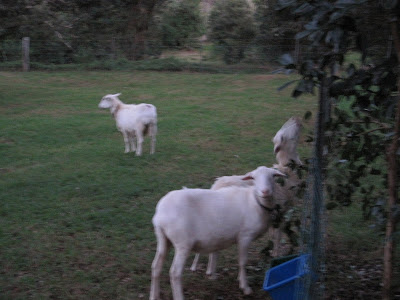


Being a modern and productive farm, we have three working lawnmowers. They are state-of-the-art, self-powering, biofueled models, and they never break down. They don't work as fast as some other mowers, but they are very thorough.


Meet the newest members of the MKTG family, Noah and Blossom. Noah is 3 months old and Blossom is almost 1 year old. When she gets a little older she'll provide fresh milk for the farm. We spent most of this week building a new pasture for them to frolic and eat to their heart's content. They were raised on a sort of goat version of "attachment parenting" so they cried and cried when we first got them, but they seem happy and are adjusting well.



Here you can see the rare and elusive Koji bear, once thought to be extinct in this part of the world, but we have one in captivity! Due to deforestation and the introduction of invasive species to the island, his natural diet of orange juice popsicles was severely depleted. We're happy to say he's making a full recovery and we hope to release him into the wild as soon as his mom says it's OK.

Saturday, February 27, 2010

Tsunami

Hi everyone. I'm sure you have all heard about the earthquake in Chile and the resulting tsunami headed for Hawai'i. Sus and I woke up this morning planning to head out for another Saturday at the beach, but we immediately heard the tsunami siren echoing up the valley from Honoka'a. Kimberly came down to our cabin as we were eating breakfast to tell us about the situation.

Luckily Honoka'a is set back from the sea on a 1000 foot cliff. The farm being even higher at over 2000 feet we knew we were safe, so we headed down the mountain into cell phone range to call our families. Our friend Mike saw us on the side of the highway and offered to take us to a spot he knows where we could watch for the swell of water that was expected. We heard there would be a wall of water from 6-12 feet in height heading past the island and we wanted to see it firsthand. Being from Boston we have no natural disasters except hurricanes, and we only get a storm that warrants evacuation once or twice a decade.

The waves were supposed to hit Hilo, about 45 miles south of us, at 11:00 AM. We waited until 11:30 and didn't see anything. Maybe we missed it, or maybe we couldn't see anything from 1200 feet up. Now we're back in town at Chase and Mohamed's place, watching the news and glad that the worst waves that hit us were only 3 or 4 feet high. Some people even surfed through the morning down in Kona. In any case, we're fine and happy, but please send your prayers and energy to those in Chile who have been hit hardest. Take care.

Tuesday, February 16, 2010

Another beautiful day...

Hi everyone,

We just finished harvested another field of tea today. Hot sun and a cool breeze help keep the tea leaves dry enough for picking. It's a good feeling looking at a bright green flush of new tea buds and knowing they will soon be in someone's cup, warming them on a cool night. We heard 49 of the 50 states were blanketed in snow last week.

It's still hard to get used to the climate here. It does get chilly at night (like around 50 degrees, which is still cold when you live in a tent) but in terms of temperature there is little variation between summer and winter. Coming from 25 years in Boston, I'm used to below freezing in February. Here, if you plant a seed it will grow regardless of season. The trees around our cabin are putting out flowers, little splashes of red and orange waving high in the wind.

Our farm is really starting to feel like home. We now refer to our cabin as "the house" and our outhouse as "the bathroom". Our tent hasn't become "our room" but it is "bed". Still, I don't know if I could ever feel that I am more than a visitor to this tropical isle.

It seems ironic that agriculture, the thing which has allowed people for thousands of years to stay put and feel this sense of "Home", is the same thing that has made me a nomad.

Saturday, February 13, 2010

Pictures part nine


The sunshade I set up for our tent, made from a 15-foot ohia log and a big tarp.


Moving our outhouse when the hole filled up (an emergency late-night maneuver).


The neighbor's horses, Kea and Ginger.


Cookin' up something good!

Pictures part eight


We painted our shower!


Our vegetable garden


The view from Chase and Mohamed's apartment

The life of a tea field

Hello again friends, I would like to show you briefly how we we turn overgrown hillsides into productive tea fields.

First, obtrusive grasses and plants are removed and the grass is shallowly tilled to break up soil compaction and improve drainage. Tea plants are sensitive to moisture and need healthy soil that does not hold too much water.


If the slope is uneven or too steep, it needs to be leveled so water does not collect in some places and run too fast in others, washing topsoil away. To be certified organic, a farm must have a no-grow zone of 25 feet between crops and neighboring property. The sticks represent the start of the rows. These rows have been freshly composted.


The field is then spread with wood chips inoculated with mushroom spores, and a solution of sugar and microorganisms is sprayed to promote mycelial growth. Mycelia will bond with the roots of the tea plants and protect them from harmful nematodes and bacteria. We have planted a catchment crop of rye, sorghum, and black mustard in order to loosen the soil and soak up extra water and nutrients.


Once the terraces are set and the soil is ready, tea cuttings are transplanted from one-gallon pots to the field, set two feet apart in rows six feet apart. Mulch is set around the plants to keep the roots warm and the topsoil in place (the mountainside in winter is cold and wet).


From this point it is a matter of keeping the plants healthy by discouraging weeds from growing too close to them and maintaining soil quality.


These plants we harvested are four years old.


And that's where your tea comes from!

Monday, February 8, 2010

The fruit of our labors

Last week Taka brought us a tin of the tea we harvested two weeks ago, freshly roasted. The smell of it was so tantalizing, and the taste was wonderful! The next time you drink a cup of tea, think of the place it came from (usually India for black teas, other parts of Asia for green), and the workers who picked it. It tastes even better that way.